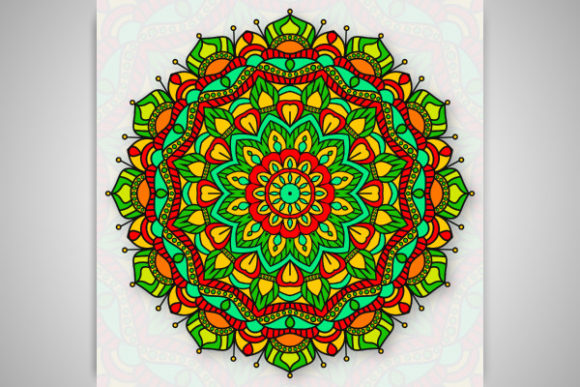
Decorative Colorful Mandala Design for Creative Projects
A decorative colorful mandala design is more than just a pretty pattern; it is a versatile artistic element that brings balance, symmetry, and vibrant energy to any visual project. At its core, a mandala is a spiritual symbol in Hinduism and Buddhism representing the universe, but in modern graphic design, it serves as a powerful tool for decoration and communication. When you encounter a decorative mandala with colorful ornament, you are looking at a composition where intricate details meet bold hues, often inspired by oriental aesthetics. These designs are characterized by their radial symmetry, meaning they radiate from a central point, creating a sense of harmony that naturally draws the eye.
The appeal of these graphics lies in their ability to transform simple layouts into professional masterpieces. Whether you are designing a greeting card for a wedding, a banner for a festival, or a poster for a yoga studio, a well-crafted mandala adds an immediate layer of sophistication. The "oriental style" mentioned in many of these assets often refers to the use of flowing lines, floral motifs, and specific color palettes that evoke traditional Asian art while maintaining a contemporary feel. This blend makes the design accessible to a wide audience, bridging the gap between cultural heritage and modern digital needs.
Why Choose Vector Graphics for Your Designs?
When selecting assets for your work, the file format matters significantly. A high-quality decorative colorful mandala design is best utilized when it is provided as a 100% vector file, typically in EPS format. Unlike raster images (like JPEGs or PNGs) which are made of pixels and can become blurry when enlarged, vectors are built on mathematical equations. This means you can scale a mandala from the size of a business card to a massive billboard without losing a single pixel of clarity.
For professionals using Adobe Illustrator, this capability is essential. Since all graphics in these collections are fully editable, you have complete control over every aspect of the image. You are not stuck with the default colors or shapes. If your brand requires a specific shade of blue instead of red, or if you need to remove a small decorative element to fit a specific layout, you can do so instantly. This flexibility turns a static image into a dynamic component of your workflow, allowing you to customize the design to match your unique vision perfectly.
Practical Applications for Creators and Businesses
The versatility of these designs allows them to be used across a vast array of contexts. For entrepreneurs and small business owners, a decorative mandala with colorful ornament can elevate marketing materials. Imagine a local coffee shop wanting to promote a new seasonal blend; placing a vibrant, oriental-style mandala on a flyer or social media banner can create an inviting atmosphere that suggests warmth and community. The symmetry of the design works exceptionally well for logos, icons, and watermarks, providing a focal point that looks intentional and polished.
Educators and bloggers also find immense value in these assets. A teacher preparing a worksheet on geometry or culture might use a mandala to illustrate concepts of symmetry and patterns. Similarly, a lifestyle blogger writing about mindfulness or travel could incorporate these graphics into headers or sidebars to break up text and add visual interest. Because the files are in RGB color mode, they are optimized for screens, making them ideal for digital presentations, website headers, and email newsletters. The high-resolution nature ensures that even on Retina displays, the fine details of the ornamentation remain crisp and sharp.
For hobbyists and freelancers, these templates save hours of design time. Instead of spending days drawing complex geometric patterns from scratch, you can start with a well-organized shape set and focus on the creative editing. The fact that all objects are editable means you can experiment freely. Try changing the background color, rearranging the layers, or combining multiple mandalas to create a completely new pattern. This freedom encourages creativity and helps beginners build confidence in their design skills without needing advanced illustration techniques.
Understanding the Technical Advantages
Beyond the aesthetic beauty, there are practical technical reasons to choose a professionally structured mandala file. One of the most critical features is the organization of the shapes. In a poorly constructed vector file, hundreds of paths might be tangled together, making it difficult to select or move individual elements. However, a high-quality asset comes with well-organized shapes. This means layers are named logically, grouped appropriately, and locked where necessary. This structure drastically reduces frustration during the editing process, allowing you to work efficiently even under tight deadlines.
The inclusion of a sample preview in JPEG format is another helpful feature. Before purchasing or downloading a full package, seeing a rendered version gives you a clear idea of how the final product will look in a real-world scenario. It acts as a bridge between the raw vector data and the finished artwork. Once you download the main file, you can open it in Adobe Illustrator and immediately see the potential. The ability to edit object colors is particularly useful for branding. If you are working on a project with strict corporate guidelines, you can quickly swap out the vibrant oranges and teals of the original design for your company's specific hex codes, ensuring consistency across all your materials.
Important Considerations Before You Start
While these designs are incredibly user-friendly, there are a few things to keep in mind to get the best results. First, ensure you have the appropriate software installed. While some viewers can open EPS files, full editing capabilities require vector software like Adobe Illustrator, CorelDRAW, or Affinity Designer. Second, consider the context of your audience. While colorful mandalas are generally popular, the intensity of the colors should match the tone of your message. A bright, energetic palette might work for a summer festival poster, whereas a more muted version might be better for a formal invitation.
Another consideration is the complexity of the design. Oriental-style mandalas often feature intricate details that can look stunning but may require careful handling when scaling down. If you plan to use the design on a very small print item, such as a stamp or a tiny tag, check the resolution to ensure the fine lines do not disappear or become muddy. Finally, always respect the licensing terms associated with the graphic. Most high-quality vector packs allow for commercial use, but it is good practice to verify the specific rules regarding redistribution or modification.
In summary, a decorative colorful mandala design offers a perfect intersection of art and utility. Whether you are a seasoned graphic designer looking for a quick asset to enhance a client's brand, or a beginner eager to learn the basics of vector editing, these resources provide a solid foundation. The combination of editable colors, scalable vectors, and culturally rich imagery makes them an invaluable addition to any creative toolkit. By leveraging these tools, you can produce high-quality visuals that resonate with your audience and effectively communicate your message.